100 Pulled From Mississippi After Tanker Capsizes New Orleans Riverboat
Horn blasts, then 191 people and a riverboat going over sideways.

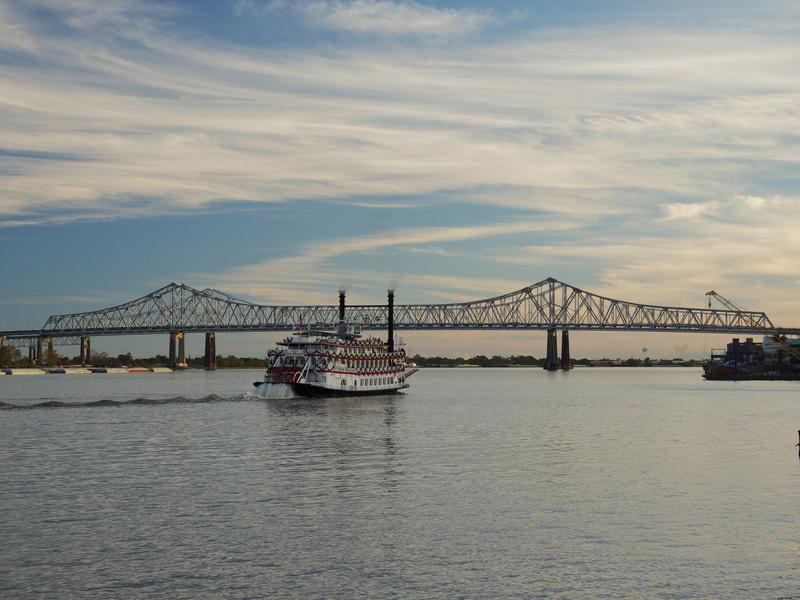
A tanker that appeared to lose steering on the Mississippi River slammed into a paddlewheel cruise boat tied up at the Port of New Orleans on Friday, rolling the smaller vessel onto its side and dropping roughly 100 passengers and crew into the water. Every one of them came out alive.
New Orleans Mayor Helena Moreno said 191 passengers and crew members were aboard the American Heritage when the tanker Atlantic Asphalt struck it at about 12:30 p.m. The riverboat had been docked roughly two hours at the Thalia Street Terminal so passengers could walk off at the end of their trip.
Thirty-two people were taken to hospitals from the scene. Officials said Friday that none of the injuries were critical, and no one aboard the tanker was hurt. Moreno called the outcome a "miracle on the Mississippi."
A horn, a dropped anchor, then the roll
The Atlantic Asphalt appeared to lose control as it passed beneath the Crescent City Connection bridge, then veered to the right and hit the docked riverboat.
People on board got their first warning when the tanker blasted its horn several times as it came toward them, passenger Joe Knab told WDSU-TV. The hit was hard and the American Heritage immediately started leaning. Crew members gathered everyone on the third deck, put life vests on them and began moving them off the boat.
Then it rolled. Harbor Police Chief Melanie Montroll said officers got more than 80 people off the vessel before it capsized, and she estimated the boat went over within 30 to 45 minutes of the collision. The exact timeline is still being worked out by investigators.
Montroll said getting vests on passengers while they waited their turn to disembark is what she considers the biggest reason the day ended without a death. Officials also credited the speed of the emergency crews and the boats already on the river.
What passengers saw from the deck
Peggy Cooper of Titusville, Florida, was aboard with her husband, Meredith. She told WFTV she had just stepped out of her room when she looked down the hall. "I saw this big green nose coming at us, and I thought, what's he doing? And next thing you know, I saw him drop an anchor, and it didn't do him any good," she said.
"I thought it was going to hit me nose on, but it hit the room below us and to the right of us just a little bit, which helped save us. But it knocked me across the wall about 10 feet in the air," Cooper said.
Rhonda Akers, who was also on the riverboat, told NBC News she had to crawl her way out. "After the initial crash, it hit us again and we flipped over and I had to crawl over the railing and people to save myself," Akers said. Her husband was hospitalized with a head injury.
Jamie Holford watched from shore and told CBS News he saw the American Heritage hit the dock, then watched people hurry off and others climb over the railings as it went over. "It looked like something off the Titanic," he said. Asked what the collision sounded like, Holford said, "It sounded like a war movie. Just imagine tons of steel crunching. That's what it sounded like."
Tugboats, barge crews and private boaters joined in
Port NOLA Harbor Police, the New Orleans Fire Department, the New Orleans Police Department and the U.S. Coast Guard all worked the rescue. So did whoever happened to be on the water. Moreno said private vessels on the river at the time responded "as volunteers to try and get people out of the water," and that a boat from a local barge company pulled more than a dozen people out on its own.
Tugboat operators, other cruise ship captains and nearby workers also pitched in. The water was 66 degrees Fahrenheit.
Knab, who is from Wichita, Kansas, said he was in the river about 15 minutes. "I thought I was drowning because I kept bobbing underneath," he told WDSU-TV, still wearing the mud-caked jeans he had on when the boat went over. He credited his 20 years in the Navy. "They taught us not to drown," Knab said. His belongings went into the river, though his cellphone somehow still worked.
President Trump praised the Coast Guard and other agencies in a Truth Social post for "doing such an incredible job of rescue, and other work, having to do with the crash of the two ships in Louisiana."
Eight people were still hospitalized a day later
Jen Avegno, the deputy mayor for health and human services, said 32 people were taken to hospitals Friday: 30 passengers and crew, plus two responders. Two more people went in later to be evaluated.
Eight remained hospitalized Saturday, two of them in serious condition and six stable, Moreno said. Montroll said two of her officers were hospitalized during the rescue and were in good condition.
The captain refused to leave
The American Heritage's captain was hurt in the collision and stayed aboard anyway. Moreno said he was the last person off the vessel and would not accept medical treatment until he knew where every passenger and crew member was.
"Every moment of the critical time [Friday], he did not want to leave his ship," Moreno said.
Investigators pulled the tanker's data recorder
Coast Guard Capt. Melanie Burnham said early reports pointed to a steering problem on the tanker. "The investigation is still ongoing, there seems to be some kind of a loss of steering," she told reporters. "The exact reason why, we don't know that."
Burnham also said she has no indication the crash was related to terrorism in any way, while noting investigators will keep working through it.
The National Transportation Safety Board sent a Go Team and recovered the Atlantic Asphalt's voyage data recorder, which captures speed, course and audio from the bridge. "It's like a flight data recorder on an aircraft. We can look at speeds and all kinds of information," NTSB board member John DeLeeuw said.
DeLeeuw said 16 investigators were on scene and preparing to interview crew members and others involved, and that the team will also examine the tanker's maintenance records and mechanical history. The team expects to spend a week in New Orleans. Their arrival was delayed by a nationwide airport ground stop.
A preliminary report is expected in about 30 days. The final report, with probable causes and any safety recommendations, is expected in 18 to 24 months. DeLeeuw said the agency is early in gathering evidence and has reached no conclusions.
The port went to court the same night
Hours after the crash, the Board of Commissioners of the Port of New Orleans filed suit in the Eastern District of Louisiana naming the Atlantic Asphalt MV, owner Nave Shipping SA and management company Thome Ship Management Pte Ltd. as defendants. The port is seeking at least $1 million for damage to the Thalia Street Terminal.
"The extent of said damage remains under investigation, but physical damage is currently estimated to exceed $1,000,000, with additional substantial direct, indirect and consequential damages anticipated," the lawsuit says. The port also expects cleanup, survey, repair, replacement and salvage costs.
The filing blames "negligence, gross negligence, fault or carelessness" and leans on a legal presumption: when a moving ship strikes a securely moored one, an event the suit calls an allision, fault is presumed. A federal judge approved the port's request, and an arrest warrant was issued directing federal marshals to seize and hold the tanker. The port asked that the vessel be sold to cover the damage.
The port's lawyers are Christopher Hannan, Sara Kuebel and Abigail Weiland of the New Orleans firm Jones Walker. Court records show the case was allotted to federal magistrate Karen Wells Roby and U.S. District Judge Wendy Vitter, chief judge at the federal courthouse in New Orleans.
Thome posted a statement Saturday confirming the Atlantic Asphalt's crew was safe and accounted for and that the tanker had been separated from the riverboat and anchored for damage assessments. "OSM Thome is fully complying with the local authorities as they carry out the necessary investigations," the company said, thanking everyone who responded "with urgency and humanity."
Weeks, not days, to clear the wreck
Before salvage crews can move the American Heritage, they have to take about 16,000 gallons of fuel off it. Divers were expected to assess the vessel, and response teams were monitoring the river. Burnham said crews had not observed anything in the water requiring removal.
"As the mayor said, we're talking weeks, we're not talking days, we're talking weeks. So we're going to do this safely, and we're going to make sure that it's done right," Burnham said.
A 3-mile stretch of the Mississippi was shut down Friday. The Coast Guard reopened it to one-way traffic late that night and allowed limited two-way traffic in the main channel Saturday. A 500-foot safety zone remains around the wreck. The Atlantic Asphalt was towed from the crash site and moored at the Perry Street Wharf on the west bank in Gretna.
Two very different boats
The American Heritage was built in 2015 and is operated by American Cruise Lines. It stands five stories and holds up to 150 passengers. The boat was finishing an eight-day cruise to several Mississippi River destinations when it was hit. American Cruise Lines said it is coordinating with local officials to help displaced passengers.
The Atlantic Asphalt was sailing under a Marshall Islands flag with New Orleans as its final destination, according to the tracking service MarineTraffic. Its registered owner, Nave Shipping SA, is registered in Monrovia, Liberia, according to the International Maritime Organization, and is a subsidiary of the Chinese state-owned conglomerate China State Shipbuilding Corporation, according to MarineTraffic. The ship hauls asphalt and bitumen, the semisolid material used in road paving and roofing.
Most read
This week
World
148 Sickened Aboard Caribbean Princess, CDC Says

Business
Allstar Recalls 265,000 Sharper Image Fire Pits After Burns
Business
18 Hurt in Missouri Crash Involving Prison Bus and Ethanol Tanker
Entertainment
Larry Poindexter Dies at 66, Days After Being Hit by Car
Politics
Trump Faults Vance for Not Defending Iran War Decision, Report Says