Lake Powell and Lake Mead Drop to Lowest Level Since 1957
The last time the West saw water levels like this, a very different president was in charge.

Turn on the tap in Phoenix, Las Vegas, or Los Angeles, and the water pouring out probably started as snow on a Rocky Mountain peak. That snow melts in the spring, feeds the Colorado River, and gets parked in two giant reservoirs long before it ever reaches a kitchen sink. Right now, both of those reservoirs are closer to empty than they have ever been.
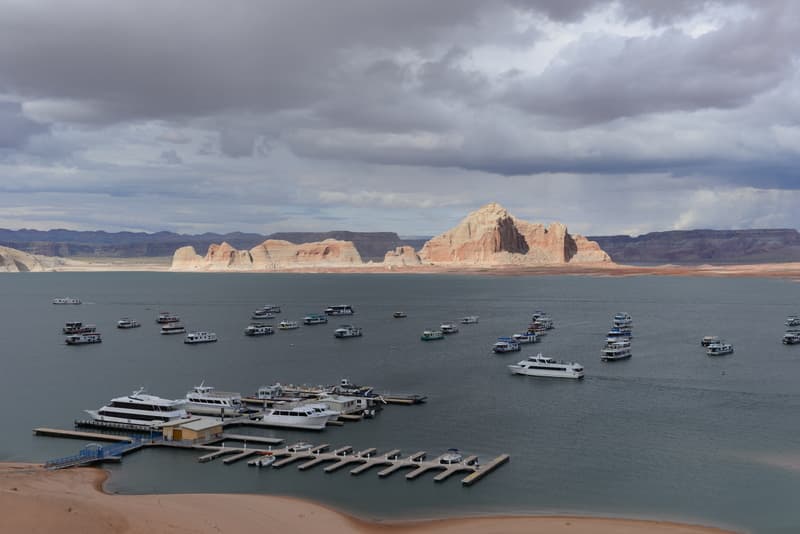
Lake Powell and Lake Mead, the two biggest reservoirs in the United States, just fell to their lowest combined water level on record. On July 12, 2026, Lake Powell sat at 3,524 feet and Lake Mead at just under 1,043 feet. Stack them together and you have to go back nearly 70 years to find a time when they held this little water. That is not a rough patch. That is the driest these tanks have been in modern history.
The Numbers Are Genuinely Ugly
Here is how thin things have gotten. Lake Powell, on the Utah-Arizona border, is about 23% full. Lake Mead, sitting right outside Las Vegas, is around 27% full. Neither one is anywhere near half. A group of five respected Colorado River experts ran the numbers and pointed out something people often miss. The two lakes are usually reported separately, but when you count them as one system, they hold less than a quarter of their capacity.
And it is not stopping. The same researchers expect the two reservoirs to set a brand new record low almost every single day from now until next spring, when the winter snowmelt finally starts trickling back in. Powell is already at its lowest July level ever recorded, and Mead is sitting less than a foot above its all-time low from July 2022. Between the two of them, they hold slightly less than 60% of all the water stored anywhere in the entire Colorado River basin. When those two go dry, there is not much of a backup plan.
A Record That Goes Back to Eisenhower
The last time these reservoirs held this little water was in 1957. Think about what that means. Dwight Eisenhower was in the White House, and Lake Powell did not even exist yet. Crews were still busy building the Glen Canyon Dam that would eventually create it. So the combined storage today matches a moment from before one of the two lakes was born.
Jack Schmidt, who runs the Center for Colorado River Studies at Utah State University, did not sugarcoat it. He called the new record "a significant moment" and told reporters, "We've never been in this position. We are truly in uncharted territory." In another interview he was even blunter, calling it "a hell of a milestone" and a teaching moment about just how serious the crisis has gotten. When the guy who studies this for a living is out of comforting words, that tells you something.
The Dam That Could Stop Making Power
Drinking water grabs the headlines, but there is a second problem tucked inside these numbers, and it is arriving fast. If Lake Powell drops just 33 more feet, the water gets too low to spin the turbines inside Glen Canyon Dam. That is the point engineers call "minimum power pool." Below it, the dam simply cannot generate electricity anymore, and water can no longer move through it into the river below.
That dam produces enough electricity to power roughly 700,000 homes. A federal report warned that Powell could hit that power cutoff by spring 2027 if the decline keeps up. Drop even further and you reach "dead pool," the level where no water flows downstream through the dam at all. Nobody wants to find out what happens after that, which is exactly why officials keep using words like "urgent."
Seven States, Zero Agreement
Here is where it gets messy. The Colorado River is split between two groups of states that do not exactly send each other holiday cards. The upper basin is Colorado, Wyoming, Utah, and New Mexico. The lower basin is California, Arizona, and Nevada. For years these seven states have argued over who should give up water first, and the fighting has slowed down real solutions.
To break the logjam, Interior Secretary Doug Burgum sat down virtually with all seven basin governors on July 21, right before the federal government moved to release new rules on how much water each state gets. Burgum thanked the governors for their "leadership" in public, but the backdrop to that meeting was grim. One detail that got buried in the negotiations: the health of the river's own ecosystem was largely left out of the talks. The people at the table were focused on cities, farms, and power, not fish and canyons.
California Got Off Easier Than It Could Have
For a while it looked like the Trump administration might force enormous cuts on the lower basin. Federal officials had the authority to demand reductions nearly twice as large as what the states offered up on their own. That would have been a gut punch for California, Arizona, and Nevada.
Instead, the feds signed off on a deal much closer to what the three states proposed. Under the plan, they will cut at least 3.2 million acre-feet from the river between now and the end of 2028. Broken down, California takes about 12% less, Arizona cuts roughly 31%, and Nevada trims around 28%. California, in particular, dodged the worst of it. And remember, the lower basin states had already cut their river use by close to 20% since 2015. So these are not people who have been sitting around doing nothing. They have been tightening the belt for a decade, and the reservoirs still hit rock bottom.
Why the River Keeps Shrinking
Two things are squeezing the Colorado River from both ends. On the supply side, the water starts as snow in the Rockies, and a warmer climate has meant less snowpack and less snowmelt feeding the river each spring. The winter of 2025 into 2026 delivered record-low snow, which is a big reason this year got so bad so fast. Today, about 95% of the basin is in drought.
On the demand side, the West keeps growing. More people move to Phoenix, Vegas, and Southern California every year, and every one of them expects water to come out of the faucet. The river has shrunk dramatically over the past 25 to 27 years while demand kept climbing. Less coming in, more going out, and the gap gets covered by draining the reservoirs. That math only works for so long, and we are now watching what happens when it stops working.
What This Actually Means Out West
The scale here is easy to underestimate. The Colorado River provides water for around 40 million people across seven states, plus a chunk of northern Mexico. It irrigates more than 5 million acres of farmland, the kind of land that grows a lot of the winter lettuce and vegetables that show up in grocery stores across the country. Farmers use the majority of the river's water, which means the deepest cuts eventually land on agriculture.
For regular people, bigger cuts tend to show up in a few familiar ways. Cities pay more to secure the water they need, and those costs can trickle down to water bills. Outdoor watering rules get tighter, so lawns, car washing, and golf courses often take the first hit. And farmers who fallow fields grow less food, which can ripple out to prices at the store. None of that is a prediction. It is simply how these cuts have played out before when the taps get squeezed.
The Part Nobody Wants to Say Out Loud
The temptation every year is to cross your fingers and wait for a big winter to bail everyone out. Schmidt, the Utah State researcher, called that mindset out directly. "I worry that there remains too much hope that we will be saved by the coming winter snowpack," he said. "Hope and prayer is no way to run a national water system."
That is the whole story in one sentence. A single good snow year could buy some breathing room, but it will not refill lakes that took a quarter century to drain. The new federal rules and the state cuts are real steps, and California avoiding the harshest reductions counts as good news for millions of people. But the reservoirs are still setting a fresh record low nearly every day, and they will keep doing it until spring at the earliest. For a region built entirely on this one river, the message from the water line is pretty simple. There is a lot less to go around than anyone planned for, and pretending otherwise is not an option anymore.
Most read
This week