Elon Musk 'Freaking Out' About Looming Bombshell Report
An ex-girlfriend, a Nobel laureate, and a text about space lasers.

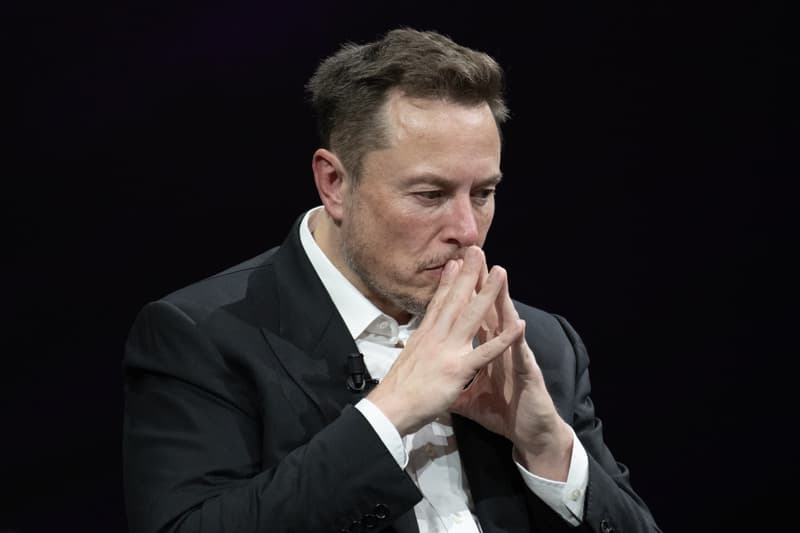
Ashley St. Clair, a former conservative influencer and the mother of one of Elon Musk's children, says the world's richest man seemed to know how the 2024 presidential election would end before a single vote was counted. She makes the claim in a new documentary, and the film flashes a text message on screen to back her up. In it, Musk allegedly tells her, "I have ten thousand lasers in space."
The movie is called "Musk," and it comes from Alex Gibney, the Oscar-winning filmmaker who has previously gone after Scientology, Enron and Vladimir Putin. It runs close to four hours. It premieres Sept. 8 at the Venice Film Festival and opens in American theaters on Oct. 16.
Musk did not sit for an interview and has spent years attacking the project as a "hit piece." He is all over the movie anyway, which was built from archival footage and interviews with people who have known, worked with or studied him.
The text about lasers in space
St. Clair, 28, is one of the film's central figures. She describes Election Night 2024 and says Musk, 55, carried a "degree of certainty" about the outcome that "I had never seen before." Before the votes came in, she says, he told her he was going to unleash the "anomaly in the matrix."
That is when the text exchange appears on screen, showing Musk's line about the ten thousand lasers. Off camera, Gibney asks St. Clair whether Musk meant Starlink, his network of satellites. Her answer: "I mean, I don't know where else he has space lasers."
The film does not prove Starlink touched a single vote, and St. Clair says plainly that she does not know what Musk meant. Gibney lets the question hang, then asks in voiceover, "What is Elon building, what are his goals, what are his actual motivations, and do we even know this man at all?"
Musk has called it a hit piece since 2023
Musk started swinging at the film almost as soon as it was announced in 2023. Told that Gibney was making what had been billed as a definitive examination of him, Musk predicted it would be a hit piece. Gibney's answer, in effect, was that Musk had no way of knowing that yet. "How would you know?" the filmmaker said, since the movie was still being shot and Musk was not taking part.
He kept it up in August 2026 as the premiere got close, calling it a hit piece again and mocking the running time by asking whether Gibney was trying to bore audiences to death. Gibney shot back that Musk might actually like the movie, given how much of it he is in.
The people who did talk include Musk's former wife Justine Musk, journalist Kara Swisher, Tesla co-founder Martin Eberhard, technology reporter Zoe Schiffer and the artificial-intelligence researcher Geoffrey Hinton.
What DOGE could get its hands on
Musk spent more than $290 million to help send Donald Trump back to the White House, according to year-end federal filings, hosting town halls in swing states and running a daily $1 million giveaway across seven battleground states for voters who signed a petition for a PAC he created. His own lawyer later told a Philadelphia court the winners were preselected, not picked at random. He then ran the Department of Government Efficiency, Trump's short-lived cost-cutting operation, for four months in 2025. The film credits DOGE with costing 270,000 federal workers their jobs and gutting the U.S. Agency for International Development, wiping out billions of dollars in aid. The federal payroll did fall by about that many across 2025, much of it from deferred resignations that took effect after Musk left. Former USAID chief Samantha Power appears in the film to describe the fallout.
The bigger worry Gibney raises is the data. During those months, he argues, Musk's young DOGE staffers had deep access to federal computer systems holding personal information on tens of millions of Americans. Gibney has said a source who ran IT at a major federal agency told him the team had "Super Admin status to federal IT systems." In his words, they could "slide a copy of the data on all of us to SpaceX as easily as dropping a file into a folder."
Some of that concern is on the record. A whistleblower complaint was filed by the Social Security Administration's chief data officer. Two DOGE team members were later referred for possible Hatch Act violations after a political advocacy group approached them in March 2025 asking them to analyze state voter rolls it had acquired, though the government filing did not establish that Social Security data was ever handed over. Gibney is careful to say he does not know what Musk or DOGE actually did with any of the information.
A Nobel winner's warning about the midterms
Geoffrey Hinton, the Nobel Prize winner often called the godfather of AI, ties that data to the next election. "It's fairly clear to me that Trump is hell-bent on corrupting the midterm elections," he says in the film. "If you wanted to corrupt those midterm elections and you wanted to use AI, all you needed to do was get detailed information on U.S. citizens. And what DOGE did looked like just what you would do."
That is the film's real alarm. Gibney's argument is that Musk is now in position to help Trump subvert the coming midterms, and that he is no longer interested in reining in his worst impulses.
Not a genius, a con man
Gibney's core argument is that Musk is less an engineering genius than a 21st-century confidence man whose power runs on hype and stock prices. He builds the film around "The Wizard of Oz," comparing his own role to Toto pulling back the curtain to reveal an ordinary man working the machinery.
The first half stacks up accusations. Gibney alleges that Musk took credit from Tesla co-founder Martin Eberhard, pressured a woman who had his child into signing an NDA, and pumped his stock with big talk about Mars and full self-driving cars. He alleges those self-driving systems are responsible for more than 60 deaths. He also revisits the monkeys used in experiments at Musk's company Neuralink, which advocacy groups say suffered needlessly.
The most miserable man I've ever met
The portrait gets personal. Gibney told The Hollywood Reporter that someone who worked closely with Musk described him as "the most miserable man I've ever met." "So he's inflicting his misery on everyone else," the filmmaker added.
Podcaster Sam Harris, a former friend of Musk's, is blunter in the film. One person's "psychopathology and neuropsychological dysregulation," he says, is "translating into massive consequence in our politics, in our economy, in our geopolitics." He adds: "It's completely insane we have one person who's this chaotic, who's completely unelected, and has this much power."
Even Musk's father turns up. Errol Musk recalls a road trip in South Africa when a family friend had a medical emergency and died despite efforts to save him. Elon, his father says, read a comic book and showed no reaction.
Gibney sums up the danger this way, again to The Hollywood Reporter: "People assume because he's very rich that he's not crazy. But the terrifying thing might be that he's crazy and he's very rich and powerful. That's the warning bell the film sounds."
St. Clair and Musk's messy history
St. Clair and Musk have their own history, and it is not friendly. Musk is the father of at least 14 children with four different women. He publicly questioned whether St. Clair's second child, Romulus, born in September 2024, was his. After she apologised for her own past anti-transgender activism, Musk said he would be filing for full custody, claiming her statements implied she might transition a one-year-old boy. Musk's transgender daughter, Vivian Wilson, is 22. St. Clair, once a champion of hard-right causes, has since publicly broken with the movement.
When you can actually see it
Gibney, 72, started work on the film in late 2022 and thought he was done with a two-hour cut in late 2024. Then Musk poured money into Trump's campaign and took over DOGE, and the story grew. The cut screening at Venice and Toronto runs three hours and 45 minutes.
Bleecker Street releases the theatrical version in the United States on Oct. 16. A four-hour version is set to arrive on HBO in 2027. For a subject who fought the movie for three years, Musk is about to be very hard to avoid on a screen near you.
Most read
This week

Crime
Shotgun in Bend School Shooting Was Birthday Gift, Sources Say

Politics
Trump Calls on New Mexico to Rename Itself New America
Business
Air Force Instructor Ian Patterson Dies in 170-Foot Fall at Alamodome
Crime
Florida Judge Signs No-Bond Arrest Warrant for Raúl Castro

World
Nearly 12-Foot Alligator Kills Fisherman at Winter Garden Park