John Anderson, Hall of Fame Country Singer, Dies at 71
He was at the Hall of Fame's Sunday ceremony in Nashville three days before he died.

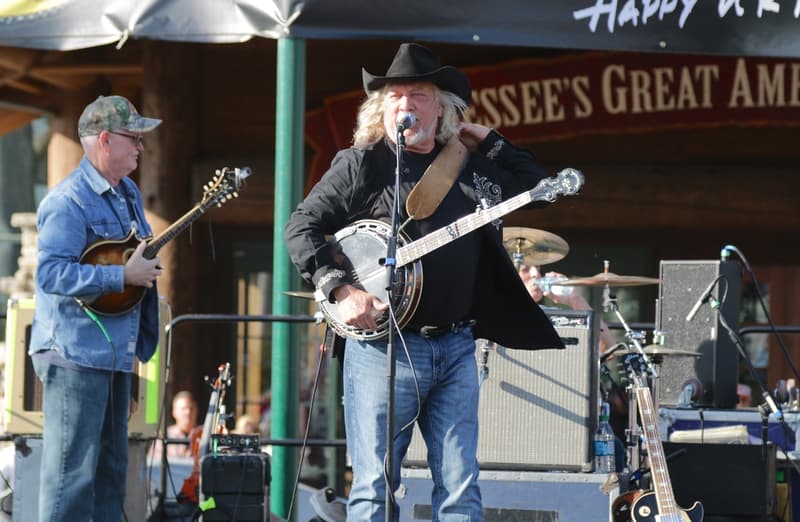
John Anderson, the Florida-raised singer whose voice carried “Swingin’” and “Seminole Wind” onto country radio in two separate decades, died Wednesday, Oct. 21. He was 71.
His family announced the death in a post on his official social media pages. “It is with the heaviest of hearts that we share the passing of our beloved husband, father, grandfather, and best friend,” the statement said.
A representative confirmed his death. Anderson had lived for decades in Smithville, Tennessee. A statement announcing his passing said he died peacefully in his sleep. The family has not released a cause.
He was born Dec. 13, 1954, and grew up in Apopka, Florida, near Orlando. Across nearly five decades he earned 20 Top 10 country hits, five of them No. 1s, and in 2024 he was inducted into the Country Music Hall of Fame.
He Was at the Hall of Fame Days Before His Death
Anderson turned up Sunday, Oct. 18, at the Country Music Hall of Fame Medallion Ceremony in Nashville, where he joined fellow members to induct Tim McGraw, Paul Overstreet and the Stanley Brothers. It was three days before he died.
McGraw wrote on social media that he spoke with Anderson that night. “He was in such good spirits,” McGraw wrote. “We talked, we laughed, we sang his songs that I loved so much together, just goofing off. I am completely heartbroken by his passing… He was and is one of the defining voices in country music.”
Parker McCollum posted that he had just met Anderson on Sunday night. “Cannot believe this. An absolute legend and one of the greatest to ever do it,” he wrote.
Reba McEntire and Tracy Byrd Left Comments on the Family’s Post
McEntire replied in a comment on Anderson’s Instagram page, calling him one of her favorite people in the business. “I sure will miss you, John. Love you and your music always,” she wrote.
Tracy Byrd added a few lines of his own. “God Bless the family, I really loved this man, he was a great singer but an even better person,” Byrd wrote.
Kyle Young, CEO of the Country Music Hall of Fame and Museum, said Anderson was a one-of-a-kind song stylist who proved that fresh innovations were best born from time-honored traditions. Young pointed to the 1981 record that put Anderson on the map. “In 1981, John famously gave life to Billy Joe Shaver’s lyric, ‘I’m just an old chunk of coal, but I’ll be a diamond someday.’ He was already a diamond then, and a diamond he always will be,” Young said in the museum’s tribute.
He Nailed Shingles on the Grand Ole Opry House Roof
In the early 1970s, Anderson moved from Apopka to Nashville, where his older sister Donna already lived, and took work as a construction laborer on the new Grand Ole Opry House. He helped nail the shingles onto its roof before the building opened in 1974.
He had been playing in garage rock bands by seventh grade and decided at age 12 that he wanted to be a professional musician. Hearing George Jones and Merle Haggard pushed him toward country. In an interview for the Hall of Fame, Anderson said he moved to Nashville to sing country music, that it was all he had ever done, and that he had no backup plan.
With the backing of music publisher Al Gallico, he signed with Warner Bros. Records in 1976. His sixth single for the label, “Your Lying Blue Eyes,” became his first Top 20 hit. Haggard, Jones and Willie Nelson gave him opening slots on their national tours. His self-titled debut album came out in 1980, followed by singles including “1959,” “Chicken Truck” and “Would You Catch a Falling Star.”
Swingin’ Sold a Million
Anderson produced the 1982 album Wild & Blue with Frank Jones. It included a cover of the traditional “Long Black Veil,” a title track that Rolling Stone later ranked No. 85 on its list of the 200 Greatest Country Songs of All-Time, and “Swingin’,” the song that turned him into a household name.
In 1983 the record won CMA Single of the Year, Anderson took home the CMA Horizon Award, and the single went on to sell a million copies. LeAnn Rimes and the Mavericks both recorded their own versions later on.
Anderson described the song as the turning point of his career in an interview with Rolling Stone, saying he and his team had already laid a good foundation with records like “Old Chunk of Coal” and “She Just Started Liking Cheatin’ Songs.” “Swingin’ pretty much crossed all the bridges,” he said. “Swingin’ was a huge record.”
More hits followed in the Eighties: “Black Sheep,” “She Sure Got Away With My Heart” and “Down in Tennessee.” The Academy of Country Music gave him its Career Achievement Award in 1993, and the Nashville Songwriters Hall of Fame inducted him in 2014.
His Label Thought Seminole Wind Was Too Regional
Nine years passed between No. 1 singles. “Straight Tequila Night” ended the drought in 1992 and kicked off a run of seven more Top 10 records, including “When It Comes to You,” “Money in the Bank” and “I Wish I Could Have Been There.”
The Seminole Wind album carried that comeback. Anderson wrote the title track alone, an homage to his home state, and his record label worried the song was too regional to work nationally. He debuted it live in Seattle, about as far from Florida as the continental United States allows, and the crowd gave him a standing ovation. He knew then he had a hit on his hands.
His five chart-toppers were “Swingin’,” “Black Sheep,” “Money in the Bank,” “Straight Tequila Night” and “Wild and Blue.” Those records helped push country music back toward its older, rawer sound in the 1980s and then did it again a decade later.
Younger Artists Kept Showing Up at His Door
John Rich produced Anderson’s 2007 album Easy Money. In 2020, Dan Auerbach of the Black Keys and David Ferguson brought him into the studio for Years, a rootsy record that included “Tuesday I’ll Be Gone,” a duet with Blake Shelton.
Auerbach said he had always loved Anderson’s voice and that Anderson always seemed to have songs he loved. “Some of them seemed old, some of them seemed new, but it was just always that voice, that unmistakable thing,” Auerbach told Rolling Stone.
Auerbach went on to assemble a 2022 tribute album, Something Borrowed, Something New, with Eric Church, Tyler Childers, Sierra Ferrell, Sturgill Simpson and Ashley McBryde interpreting Anderson’s catalog. Luke Combs took “Seminole Wind.”
He Got Into the Hall of Fame While He Could Still Enjoy It
Anderson entered the Country Music Hall of Fame in 2024 alongside Toby Keith and guitarist James Burton. “One of the main gratifications is I got to live to see it,” he told Rolling Stone. “Several of my friends were inducted posthumously.”
Speaking about the honor, he called the museum an institution that preserves greatness and said that getting the chance to be among that kind of greatness was something words could not explain. He thanked the fans who had supported the music and the shows for 50 years, saying he could never have done it without them.
Tradition was the whole point for him. He told Rolling Stone that real country music and the traditional country sound meant a great deal to him, that he came to Nashville young and dedicated his life to doing country music the way he thought it should be done. He credited Johnny Cash, Haggard, Waylon Jennings and Jones with teaching him, and said their advice boiled down to one thing: keep doing what you do.
He Talked Openly About Dying
He talked openly about mortality in a 2020 interview with Rolling Stone. “I’m still scared as hell of dying,” he said. “On the other hand, when my time comes, I think I’ll be in great hands. That part of it makes things better. Faith is a big part of living, and hope is a big part of living.”
Anderson married his wife, Jamie, in 1983, the same year “Swingin’” won Single of the Year. The Hall of Fame page that lists his 20 Top 10 hits now carries the years 1954 to 2026.
His family closed its statement by asking for thoughts and prayers. “His music will live on, but for us, his greatest legacy will always be the love he gave his family and the memories we will carry with us forever,” they wrote.
Most read
This week

Crime
Homicide Detectives Investigate Singer Gus Ormo's Death in Pool

Crime
Man, 65, Found Dead Under Disneyland Resort Entrance Sign
Business
Explosion Ignites Fire at World's Largest Quaker Oats Mill in Iowa
Sports
Pete Banaszak, Raiders Back in Holy Roller Play, Dies at 82

Crime
Becky Drury Says She Played Dead in Bend School Shooting