Pete Banaszak, Raiders Back in Holy Roller Play, Dies at 82
One swipe at a loose ball changed the NFL rule book forever.

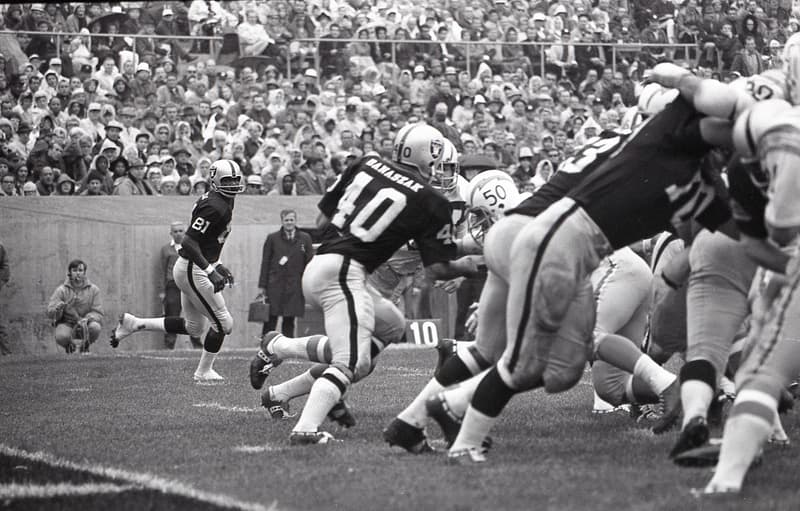
Pete Banaszak, the Oakland Raiders running back who scored two touchdowns in Super Bowl XI and knocked the ball forward on the Holy Roller, has died at 82. The team announced his death on Oct. 24.
Banaszak spent all 13 of his professional seasons with the Raiders, from 1966 through 1978. He played 173 regular-season games and ran for 3,772 yards and 47 touchdowns, mostly as a short-yardage back who came in when the Raiders needed two feet and could not afford to miss.
"The Raiders Family mourns the passing of Pete Banaszak, whose toughness, competitive spirit, and dedication embodied a legendary era of Raiders football and made him a cherished member of the Silver and Black," the team said in a statement.
The Holy Roller, and the rule it forced
Week 2 of the 1978 season, Banaszak's last, gave him the play he is best known for. The Raiders trailed the San Diego Chargers 20-14 with seconds left when Ken Stabler fumbled while appearing to be sacked. Banaszak got to the loose ball and batted it forward instead of falling on it, and tight end Dave Casper recovered it in the end zone. The extra point finished a 21-20 Oakland win.
The league responded the next season with a rule limiting who can advance an offensive fumble on fourth down or after the two-minute warning of either half. Only the player who fumbled it may do so. The Holy Roller is one of the few plays in football history that got legislated out of existence.
Two scores in the franchise's first title
Banaszak crossed the goal line twice in Super Bowl XI, the Raiders' 32-14 win over the Minnesota Vikings on Jan. 9, 1977. His touchdown runs covered one yard and two yards, which was exactly the job he had been doing for a decade.
That game delivered the first Vince Lombardi Trophy in franchise history. Banaszak had already been to one Super Bowl with Oakland and lost it, nine seasons earlier.
Sixteen touchdowns in 1975, still a Raiders record
His best season came in 1975, his 10th year with the team. He tied O.J. Simpson for the league lead with 16 rushing touchdowns and set career highs with 187 carries and 672 rushing yards. Those 16 rushing scores remain the single-season record for the Raiders, more than 50 years later.
A 672-yard season with a share of the league lead in rushing touchdowns tells you how he was used. He was not the guy breaking off 40-yard runs. He was the guy getting the last yard.
A backup who started 36 games in 13 years
Banaszak started just 36 of the 173 NFL games he played. He was durable, appearing in at least 10 games every season he spent with the Raiders, and he finished with 192 combined regular-season and postseason games.
Teammates and fans called him Rooster. "We knew that when we gave the ball to Pete, he would get the first down or the touchdown, somehow, some way," former Raiders quarterback Ken Stabler said of him. Stabler called him the best short-yardage runner he ever saw.
Crivitz, Wisconsin, and a state discus title
Peter Andrew Banaszak was born May 21, 1944, in Crivitz, Wisconsin. He played football, basketball and track at Crivitz High School, where he was a halfback and a linebacker, made all-conference and made the honor roll.
He also threw the discus, and he was good at it. Banaszak won the Wisconsin Interscholastic Athletic Association Class C state discus championship in 1961 and again in 1962, setting a Class C record of 157 feet 6.5 inches in 1962. He ran the 100-yard dash and was on the 880-yard relay team. As a senior he stood 6 feet and weighed 200 pounds.
His father was a serious Green Bay Packers fan who took him to games as a boy and held season tickets that were eventually passed down to Banaszak's sister. In high school Banaszak thought about becoming a Catholic priest. He had an uncle and a cousin in the priesthood. A football scholarship offer sent him to college instead, though the idea stayed with him.
Miami's MVP as a senior
The University of Miami got him through assistant head coach Walt Kichefski, who was from Rhinelander, Wisconsin. As a sophomore fullback in 1963, Banaszak led the Hurricanes in rushing with 461 yards on 97 carries and added 18 catches for 201 yards.
His breakout came against Kentucky that year. Wind kept pass-first quarterback George Mira from throwing, so Miami handed it to Banaszak, who gained 90 yards on 19 carries in a 20-14 win. Leg injuries cut into his junior season, and he came back as a senior in 1965 to again lead the team in rushing with 473 yards on 111 attempts.
He finished three varsity seasons at Miami with 263 carries for 1,107 yards and nine touchdowns, plus 35 receptions for 356 yards and three scores. He graduated on the dean's list and was voted the Hurricanes' most valuable player as a senior.
A broken ankle gave him his first chance
Oakland took Banaszak in the fifth round of the 1966 AFL draft, 59th overall. He barely played as a rookie, with four rushing attempts and some special teams work.
In 1967 he sat behind leading rusher Clem Daniels until Daniels broke his ankle against the Miami Dolphins on Nov. 19. Banaszak started the last five games of the season. His first start came Nov. 23 against the defending AFL champion Kansas City Chiefs, and he led the Raiders with 81 yards on 13 carries and a rushing touchdown while catching four passes for 27 yards. Head coach John Rauch thought Banaszak could fill in.
Banaszak kept producing. He had 71 rushing yards and 56 receiving yards in a Dec. 10 win over the Houston Oilers, then 86 rushing and 73 receiving the following week against the New York Jets, including a 72-yard catch. He started the 1967 AFL Championship Game against Houston and rushed for 116 yards on 15 carries in a 40-7 blowout.
Then came Super Bowl II against the Green Bay Packers, the team his father had taken him to watch. Green Bay won 33-14. Banaszak ran six times for 16 yards and caught four passes for 69 yards from Daryle Lamonica. He also fumbled, and the Packers scored afterward. That one stayed with him.
The one season he started every game
Injuries to Hewritt Dixon and Charlie Smith opened the 1971 backfield, and Banaszak lined up next to Marv Hubbard. He started all 14 games that year, the only time in his career he started a full season, and ran for 563 yards on 137 carries with eight rushing touchdowns. He was second on the team in rushing yards behind Hubbard and first in rushing scores.
John Madden put Smith back in the starting lineup in 1972, and Banaszak did not start a game. He carried 30 times for 138 yards and a touchdown. He went back to the bench and stayed productive there for six more years.
Where he stands on the Raiders' all-time lists
Banaszak's 3,772 rushing yards came on 964 carries, an average of 3.9 per attempt, and rank eighth in Raiders history. His 47 rushing touchdowns rank second for the franchise, behind only Hall of Famer Marcus Allen.
He added 121 receptions for 1,022 receiving yards and five receiving touchdowns, finishing with 52 total touchdowns and six more in the playoffs. The Raiders never had a losing season in the 13 years he was on the roster.
A radio gig in Jacksonville after football
Banaszak made his final appearance for the Raiders in 1978 and retired after that season. He went to work for Crowley Maritime and lived in Jacksonville, Florida. In the early 2000s he co-hosted The Fifth Quarter, the Jacksonville Jaguars' postgame radio show.
The Wisconsin native was proud of his Polish heritage, the team said, and he was inducted into the National Polish-American Sports Hall of Fame in 1990.
The Raiders extended condolences to his wife, Sue, his daughters, Rebecca and Amy, his grandsons, Luke, Austin and Connor, and the rest of his family in their statement.
Most read
This week
Crime
Homicide Detectives Investigate Singer Gus Ormo's Death in Pool
Crime
Man, 65, Found Dead Under Disneyland Resort Entrance Sign

Business
Explosion Ignites Fire at World's Largest Quaker Oats Mill in Iowa

Crime
Becky Drury Says She Played Dead in Bend School Shooting
Entertainment
Tom Skerritt, Who Played Viper in Top Gun, Dies at 93