Blue Origin's New Glenn Rocket Explodes During Cape Canaveral Test
The blast was visible for miles, and the aftermath could reshape the space race.

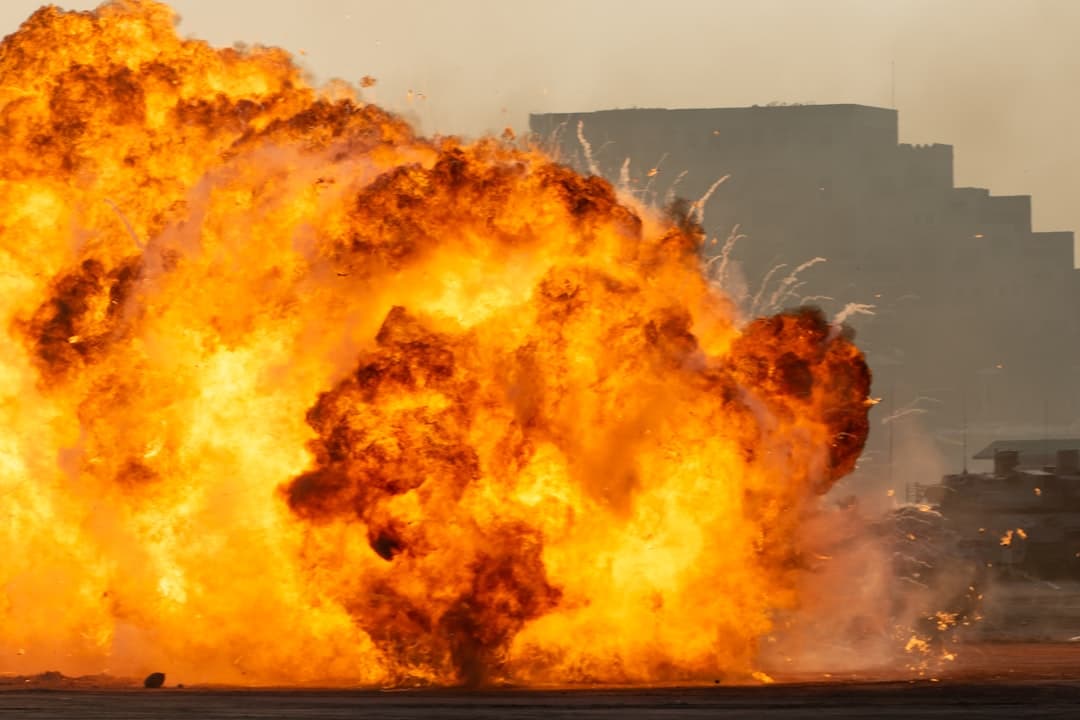
Thursday night at Cape Canaveral looked like the end of the world for about thirty seconds. Jeff Bezos' 320-foot New Glenn rocket, the pride of his Blue Origin space company, erupted into a rolling wall of fire during what was supposed to be a routine engine test. The blast shook homes miles away, lit up the night sky in orange, and left Blue Origin's only launch pad in ruins. It was, by most accounts, one of the largest rocket explosions in American history.
Nobody was hurt. But the damage to Blue Origin's plans, to Amazon's satellite ambitions, and to NASA's moon program? That's going to sting for a long time.
What Happened at 9 P.M. on May 28
Blue Origin engineers were running what's called a static fire test. That's where you bolt a rocket to the pad, fuel it up, and briefly ignite the engines to make sure everything works before an actual launch. It's supposed to be the final dress rehearsal. The New Glenn's seven BE-4 engines, which burn methane and liquid oxygen, appeared to begin firing at around 9 p.m. EDT. Then something went very wrong very fast.
Video from livestreams captured the 188-foot-tall first stage becoming swallowed by fire from the base up. Within seconds, the 86-foot upper stage started tilting and falling as the first stage collapsed beneath it. Then the whole thing blew. The methane fuel and liquid oxygen ignited in a roiling fireball that sent flaming debris and billowing smoke skyward. When the smoke cleared, the rocket was gone. The launch pad's erector gantry, the massive structure used to move the rocket from its hangar to the pad, was gone too.
Residents in Cape Canaveral and Cocoa Beach reported hearing loud blasts and feeling their houses shake. Footage from as far away as the Cape Canaveral Community Center showed the fireball glowing on the horizon. People on social media compared it to a nuclear explosion, which is dramatic but not totally unreasonable when you see the clips.
Bezos Responds, and So Does His Biggest Rival
Jeff Bezos posted on X within hours. "All personnel are accounted for and safe," he wrote. "It's too early to know the root cause but we're already working to find it. Very rough day, but we'll rebuild whatever needs rebuilding and get back to flying. It's worth it." Blue Origin's official account used the word "anomaly" to describe the explosion, which is the aerospace industry's favorite way to say "something blew up and we don't know why yet."
Then Elon Musk chimed in. Musk, whose SpaceX is Blue Origin's main competitor in basically every way, responded on X with: "Most unfortunate. Rockets are hard." He followed that up with a separate, more supportive message. Whether you read that as gracious or a little bit of a flex depends entirely on how you feel about the Bezos vs. Musk rivalry. Probably a bit of both.
NASA Administrator Jared Isaacman also weighed in publicly. "Spaceflight is unforgiving, and developing new heavy-lift launch capability is extraordinarily difficult," he wrote, adding that NASA would work with Blue Origin to support an investigation and assess impacts to its programs.
The Timing Could Not Be Worse
This explosion didn't happen in a vacuum (no pun intended). It landed at possibly the most awkward moment imaginable for Blue Origin and Amazon.
The rocket that blew up was being prepped for its fourth mission, designated NG-4, which was scheduled to fly as early as June 4. That launch was supposed to carry 48 satellites for Amazon Leo, Amazon's broadband internet constellation (formerly called Project Kuiper). It would have been the first of 24 launches Amazon contracted Blue Origin to perform for the constellation.
Here's the kicker. Amazon only has somewhere between 210 and 241 satellites in orbit right now. The Federal Communications Commission requires them to have 1,618 up there by July 30, 2026. That's barely two months away. Amazon has applied for a two-year deadline extension and contracted 22 additional launches to close the gap, but losing NG-4 and potentially months of launch capacity just compressed an already impossible schedule.
On top of all that, just two days before the explosion, NASA awarded Blue Origin a $188 million contract to land rovers on the moon's surface. Two days. You can't script that kind of timing.
Blue Origin's Only Pad Is Wrecked
This might be the single biggest problem coming out of Thursday night. Launch Complex 36 at Cape Canaveral is the only pad in existence that can launch a New Glenn rocket. It's gone. Or at least, it's severely damaged. The erector gantry that holds and positions the rocket was destroyed. The pad infrastructure is wrecked.
For context, when SpaceX lost a Falcon 9 on pad 40 back in September 2016, the rocket was grounded for about three and a half months. The pad itself was out of action for more than a year. Blue Origin hasn't given any timeline for rebuilding or returning to flight, and given that their pad damage appears at least as severe, it's reasonable to assume they're looking at a long pause.
The good news, if you can call it that: the Amazon Leo satellites weren't on the rocket yet. They were still at a separate payload processing facility and hadn't been integrated with New Glenn. So Amazon didn't lose 48 satellites on top of everything else. Small mercies.
New Glenn Was Already Having a Rough Year
The explosion didn't come out of nowhere in terms of the program's struggles. New Glenn has only flown three times total, and the track record is mixed at best.
The first flight reached orbit, which was a big deal, but the booster stage exploded before Blue Origin could attempt a landing on a drone ship. The second flight in November 2025 went much better. Blue Origin launched twin spacecraft to Mars for NASA and successfully landed the booster for the first time. The third flight in April 2026 reused that same booster, proving Blue Origin could recover and refurbish a first stage for re-use. The booster worked fine and even landed again.
But the upper stage failed on that third flight. A cryogenic leak in one of its two BE-3U engines froze a hydraulic line, and the satellite payload ended up in the wrong orbit. The FAA grounded New Glenn after the April incident, identifying nine corrective actions Blue Origin needed to take before flying again. The company had just recently been cleared to return to flight when Thursday's disaster struck.
NASA's Moon Plans Just Got More Complicated
The fallout from this explosion goes well beyond Amazon's satellite internet service. Blue Origin's New Glenn rocket is the delivery vehicle for the company's Blue Moon lander, which is a critical piece of NASA's Artemis moon program.
NASA selected Blue Origin's Blue Moon Mark 2 as one of two crewed landers for the Human Landing System program. The other is SpaceX's Starship. Both are supposed to dock with the Orion spacecraft on future Artemis missions and bring astronauts to the lunar surface. NASA wants at least one of its contracted lunar rovers on the moon before the first crewed Artemis mission (Artemis 4) touches down, a milestone targeted for late 2028.
Blue Origin had been planning to send a robotic prototype of its Blue Moon lander to the lunar surface later this year to demonstrate capabilities. Without a functioning New Glenn or a launch pad to fly it from, that plan is in serious jeopardy. Administrator Isaacman said NASA would "provide information on any impacts to the Artemis and Moon Base programs as it becomes available," which is government-speak for "we're figuring out how bad this is."
The SpaceX Gap Just Got Wider
The uncomfortable reality for Blue Origin is that this explosion widens an already large gap between them and SpaceX. Musk's company is years ahead in launch cadence, rocket reuse, and satellite deployment. SpaceX's Starlink constellation has thousands of satellites already in orbit. Amazon Leo is still in enterprise beta.
Just last week, SpaceX carried out a largely successful 12th test flight of its Starship prototype, deploying mock satellites and executing a controlled splashdown in the Indian Ocean. SpaceX also unveiled plans for an IPO earlier in May 2026, and the company is set to become the first trillion-dollar U.S. market debut.
Blue Origin, meanwhile, had been planning as many as 12 New Glenn launches this year. That number now looks like a fantasy. The company after roughly a decade of developing New Glenn is back to square one on getting its pad rebuilt and figuring out what went wrong.
The FAA Says It Won't Investigate
In a surprising twist, the FAA told reporters that the static fire explosion was "not within the scope of FAA licensed activities" and that there was "no impact to air traffic." That means the FAA won't be opening its own investigation into what happened. The investigation will be Blue Origin's to run.
The Eastern Range confirmed that all other launch complexes at Cape Canaveral remain "fully mission capable" and that national security launches and other company operations are unaffected. Brevard County Sheriff Wayne Ivey said the plan was to let the contained fire from the explosion burn itself out and confirmed there was no danger to the surrounding community.
Bezos said it himself just days before the explosion, during a CNBC appearance where he talked up Blue Origin's mission to slash launch costs by a factor of ten. "That's what we're working on right here," he told the interviewer. Right now, the work just got a whole lot harder.
Most read
This week

Crime
Jammed Rifle Stopped Aurora Temple Attack, Prosecutors Say

Politics
Trump Administration Seeks to Strip Ilhan Omar of Citizenship

Crime
Police Hunt Gunman After Second Shooting at Bakersfield TV Station

Sports
Mike Tyson Recounts Repeated Overdoses in New Netflix Docuseries

Entertainment
RJ Mitte, Breaking Bad's Walter White Jr., Dies at 34