Green Fireball Streaks Over 15 States at 56,000 MPH
A baseball-sized rock crossed 15 states in seconds, and the color was a giveaway.

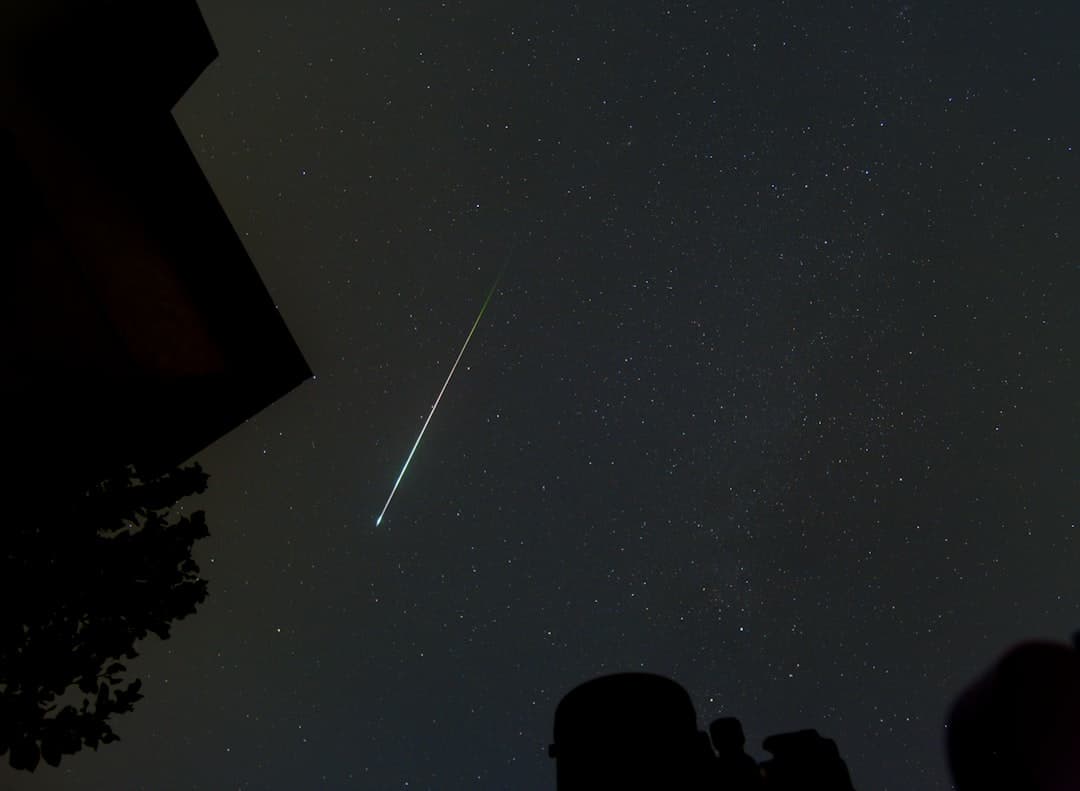
On Sunday night, June 15, a piece of space rock no bigger than a baseball put on a show that a big chunk of the country will be talking about for a while. Around 10:30 p.m. Central time, a bright green streak tore across the dark and showed up in at least 15 states. People from Texas all the way up to Minnesota looked up at almost the same moment and saw the same thing.
Nearly 400 of them reported it. Some called it in. Some posted dashcam clips before they'd even pulled into their driveways. One guy in Tennessee just said he'd never seen anything like it in his life. Here's what actually happened, what NASA's cameras caught down to the mile, and why your phone probably filled up with grainy night videos that evening.
NASA's cameras caught the whole thing
Three NASA meteor cameras were rolling when the fireball appeared at 10:26 p.m. Central. According to NASA's tracking data, the rock was moving at 56,000 mph. That's not a typo. Fifty-six thousand miles per hour. To put that in normal-person terms, a commercial jet cruises around 575 mph. This thing was going about a hundred times faster than the plane you take to visit your in-laws.
A driver in Brentwood, Tennessee had a dashcam running and caught the exact second the whole sky flashed. At its brightest point, the fireball was 16 times brighter than Venus, and Venus is already the brightest thing up there after the moon. The cameras followed it from the first image to the final flash, which is rare. That full trajectory is why scientists can tell you precisely how fast it moved and exactly where it ended.
It started over Mississippi and died over Missouri
NASA's first image of the rock came from above Tupelo, Mississippi, the birthplace of Elvis. From there it shot northwest, covering about 300 miles before it burned out. The end came 34 miles above the Mark Twain National Forest in Missouri, where it finally broke apart and went dark.
Three hundred miles is roughly the drive from Memphis to St. Louis. This thing did it in seconds. Local reports rolled in from small towns plenty of people have never heard of, including Hopkinsville and Oak Grove in Christian County, Kentucky. Two residents there officially logged the sighting around 11:30 p.m. their time, which goes to show this wasn't just a big-city thing. People standing in their yards in rural Kentucky saw it just as clearly as anyone in Dallas.
Why it glowed that bright green
A lot of people noticed the color before anything else. It wasn't plain white or orange. It was a clear, electric green, the kind that makes you do a double take. And that color is actually a clue about what the thing was.
When a fireball burns green, astrophysicists read it as a sign of a real meteor, not a stray piece of metal tumbling out of orbit. Swinburne University astrophysicist Dr. Kirsten Banks said the green tone, along with the brightness and speed, told her it was a true fireball. The color comes from the rock heating up and burning as it slams into the air at full speed. The faster it goes, the brighter and more colorful the burn gets. At 56,000 mph, it lit up like a flare.
Nearly 400 people reported it
The American Meteor Society logged the event just after 10:30 p.m. Central and collected close to 400 reports. They came from Alabama, Arkansas, Georgia, Iowa, Illinois, Indiana, Kentucky, Mississippi, Missouri, Minnesota, Oklahoma, South Carolina, Tennessee, Texas, and Kansas. Picture a map of the central and southeastern U.S. with pins dropped all over it. That's what the society's dashboard looked like by midnight.
The quotes are the best part of this whole thing. One witness in Oakland, Tennessee told the society it was "SUPER BRIGHT and lit up the whole sky." Another person over in Arlington, Tennessee kept it short and honest: "I ain't never seen anything like it. The colors were pretty and crazy." A bunch of people said the same thing, that the object seemed to break apart into pieces right before it vanished.
Don't bother going outside to hunt for rocks
First question everybody asks: did any of it hit the ground? Almost certainly not. NASA put it plainly, saying the object "moved too fast and was too small to produce meteorites." So if you were hoping to walk into the Mark Twain National Forest and find a space rock worth bragging about, you can save the gas.
How small are we talking? About one pound, roughly three inches across, likely a chunk that snapped off an asteroid somewhere out in the solar system. Researchers are still cross-checking the path, eyewitness accounts, and camera and sensor footage to see whether any tiny fragments survived the fall. But nobody is expecting to find a crater. A three-inch rock moving 56,000 mph mostly turns into light and dust before it ever gets close to the ground.
Australia got its own fireball the same night
Here's the strange coincidence. While Americans were craning their necks at a green streak, people in Melbourne, Australia spotted a fireball of their own at roughly the same time. Two different rocks, two different sides of the planet, one night. If you're the type who reads meaning into stuff like that, knock yourself out, but the two events weren't connected in any way.
Space is full of small debris, and Earth runs into bits of it constantly. Most of it burns up so high and so fast that nobody ever notices. Every once in a while, though, one is big enough and bright enough to make 400 people reach for their phones at the same time. That's what happened here, and it happened to two corners of the globe on the very same evening.
Fireball, meteor, meteorite: the quick cheat sheet
These words get tossed around like they mean the same thing, so here's the simple version. A meteoroid is the rock while it's still drifting around in space. Once it hits our atmosphere and starts burning, it becomes a meteor. If it burns especially bright, brighter than Venus, it earns the nickname fireball. And if any piece actually survives the trip and lands on the ground, that surviving piece is called a meteorite.
Sunday's rock made it to fireball status and stopped there. Experts confirmed it was a natural meteor and not man-made space junk, which is exactly why the green color and the blistering speed mattered so much to the people studying it. Old satellite parts and rocket debris burn slower and don't glow that bright shade of green.
If you missed it, you're not out of luck
The whole event lasted just a few seconds. By the time most people registered what they were looking at, it was already gone. That's the cruel part of a fireball. You can't plan for it, and blinking at the wrong moment means you miss it entirely.
The good news is that dashcams, doorbell cameras, and home security setups did the watching for everyone who was inside or facing the wrong way. Plenty of those clips were submitted for review and are floating around online, including that crisp dashcam capture from Brentwood. A one-pound rock crossed 300 miles of America at 56,000 mph, lit up 15 states, and got caught on more cameras than most concerts. Not a bad night for something the size of a baseball.
Most read
This week