Iconic Pop Artist Dead at 88
His posters hung in millions of dorm rooms. The last years told another story.
Peter Max, the artist whose rainbow-soaked posters and floating cosmic figures became visual shorthand for the 1960s, died Monday at a Manhattan hospital. He was 88. His son Adam confirmed the death in a written statement Wednesday, the Associated Press reported. No cause was given, though Max had been suffering from advanced dementia.
"We will remember his extraordinary creativity, his warmth, his curiosity, and the way he saw beauty and possibility everywhere," Adam Max said in the statement announcing the death. His art became part of American culture, he said, but the father they knew and loved is the person the family will miss most.
His daughter, Libra, said in a statement that her father was her best friend. "I hope that alongside his remarkable artistic legacy, people will remember his kindness, his gentleness, and how much he genuinely cherished putting joy into the world," she said.
Michael Pagnotta, a close friend and spokesperson who began working for Max in the mid-80s, told Rolling Stone the artist died after a long battle with Alzheimer's disease.
The poster that put Love on a rainbow
Max's "Be In" poster layered the word Love over a rainbow background, and according to his website it helped inspire "several hundred thousand hippies" to gather in New York City's Central Park during the Summer of Love. It is the image most people picture when they hear his name, even if they never knew the name.
His "Cosmic Jumper," a weightless figure in a bell-bottomed suit sailing through bands of bright color, landed on a 1974 postage stamp commemorating the Spokane World's Fair. The character showed up everywhere in his work.
Max himself made the cover of Life magazine in 1969, his dark bushy mustache framing a grin. He also drew covers for the Manhattan Yellow Pages, the business phone directory handed out to millions of people.
Berlin to Shanghai to Brooklyn
He was born Peter Max Finkelstein in 1937 to a Jewish family in Berlin. The family fled Nazi Germany for Shanghai when he was a baby, and later spent time in Tibet, Israel and Paris before settling in New York City when Max was 16. Rolling Stone reported the family spent about a decade in Shanghai and landed in Brooklyn in 1953.
By the time he got to the United States he was already, in his own words, "a huge fan of American culture": comics, movies and "all the jazz music."
He studied at the Art Students League of New York, the School of Visual Arts and Pratt Institute. The Art Students League also counted Roy Lichtenstein, Robert Rauschenberg and Cy Twombly among its former students, artists whose shift out of abstract expressionism helped open the door to the bright everyday imagery Max would run with.
In 1962 he opened a Manhattan design studio with a fellow art student, Tom Daly. Ad agencies, magazines and corporate clients took to his style almost immediately.
Seventy product lines, then he pulled the plug
The licensing business got enormous. "My work was really, I would say, almost exploited," Max said. "It was on mugs, it was on bedsheets, it was on dresses, it was on silks and scarves and ties — 70 product lines." Scarves, watches, butter dishes and bath towels all carried his designs, along with a line of art clocks commissioned by General Electric.
What bothered him, he said, was that he wasn't painting anymore. So he shut the business down for a time in the early 1970s and went back to the canvas. It is a strange move for a man whose whole reputation was built on volume, and he made it at the peak.
Pink and neon at the border
In the 1970s the federal government hired Max to design a series of "Welcome to the U.S." signs for entry points along the Canadian and Mexican borders. The designs came back drenched in bright pink, blue and yellow, and some officials questioned the psychedelic look, so the signs went into storage.
President Jimmy Carter revived the project. In 1978, the signs went up at about 160 ports of entry, greeting millions of travelers coming into the country.
Official artist of just about everything
Max was the official artist for the Olympics, the Super Bowl, the Indianapolis 500, the World Cup, the World Series and a long list of other events. Reuters reported he held the title for five Super Bowls, the 1994 World Cup, the 2006 U.S. Winter Olympics team and the 2000 Kentucky Derby, and he also made posters for the New Orleans Jazz Festival.
He painted a Boeing 777 for Continental Airlines, a ship for Norwegian Cruise Line and a race car for NASCAR star Dale Earnhardt. In 2000, he went on QVC to sell his posters.
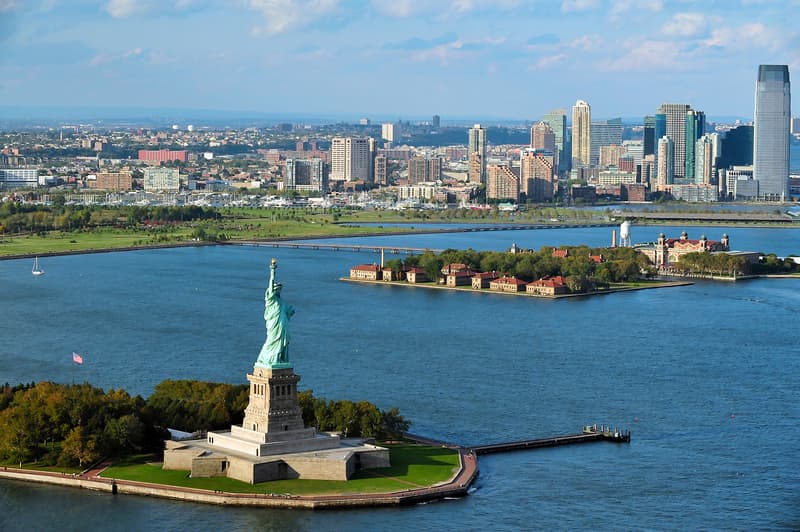
The portrait subjects ran from Bob Dylan and Ringo Starr to President Obama and Taylor Swift. He did a 40-part series on Mikhail Gorbachev, then the Soviet leader. In 1981, at the invitation of first lady Nancy Reagan, he painted a series of Statue of Liberty portraits at the White House.
Ronald Reagan was a fan, and Max donated a Statue of Liberty painting to the Reagan Presidential Library. Bill Clinton told Max that his posters had hung on the walls of Clinton's college dorm room. Decades later, a series of Max portraits of Clinton hung in the Clinton presidential library.
Sellout, or the guy who made art people could afford
Max never apologized for the commerce. "Such an explosion was monumental," he told Reuters in 2007. "I could have never gotten that kind of explosion just being in galleries."
To critics who called him a sellout, he told the New York Times that Matisse and Picasso would be rushing the market too if they were still around. "In our era, if an artist is not seen in the media, he doesn't exist," he said. "The myth that an artist is not pure if he makes money is the wrong myth... What have I got to apologize for? I make art people can afford. And that makes them happy."
He faded from public view as the '60s ended, worked privately and traveled, then returned with a New York gallery show in 1987 and rebuilt the machine. His New York studio grew to more than 100 employees in the 2000s with annual sales of $80 million to $100 million. Many works sold through cruise ship auctions, the Times reported.
Those shipboard auctions, held on lines including Royal Caribbean, Carnival and Norwegian, also brought lawsuits from buyers who said the art they got wasn't what they expected, according to Agence France-Presse.
The art establishment was said to look down on him, but his work has appeared in dozens of museum exhibitions around the world, and New York's Museum of Modern Art owns seven of his pieces. A 1967 Village Voice critique called his decorative posters the work of a visionary fascinated by time, space and evolution.
One credit that was never his: the Beatles' "Yellow Submarine." The album cover and the 1968 film are officially credited to the Czech-German illustrator Heinz Edelmann. Max claimed in a 2012 interview that he did the original design before handing it off to Edelmann, though Park West gallery, a longtime dealer of his art, described his involvement as "early consulting work."
The tax plea and the court fights
Max pleaded guilty to tax fraud in 1997 after the IRS alleged he had concealed more than $1 million in income from his art. He was originally sentenced to two months in prison, but was ultimately allowed to serve the time in a work-release program, pay the back taxes and a $30,000 fine, and perform 800 hours of community service teaching art in Harlem schools.
In 2015 his family life turned into tabloid material. His son Adam, from a previous marriage, and a guardian alleged that Max's second wife, Mary Max, had depleted his finances and browbeat him. She countered that they had kept him from her against his will and stolen paintings that belonged to her. Accounts of his court appearances described him as frail.
Mary Max died by apparent suicide in 2019, two weeks after the New York Times published a story detailing the legal battles over his work. If you or someone you know is struggling, the 988 Suicide and Crisis Lifeline is available by call or text. That May, the paper reported Max had been diagnosed with symptoms of Alzheimer's disease and had advanced dementia. He had not painted seriously in four years.
Before his death, his daughter Libra went public with a legal dispute with his court-appointed guardian, accusing the guardian of isolating her father from family and friends and withholding information about his health.
Rainbow eyes
"I see everything through rainbow eyes," Max once said, and he held that line about his own work with some stubbornness. "The colors are strong, sometimes loud, sometimes raw and sometimes harmonious, but always powerful, and the images are always on the side of the peaceful nature," he said. "I don't discuss in my paintings negative things, I don't dwell on it in my mind and don't dwell on it in my canvasses."
The spiritual side was real and it was not chemical. The New York Times described Max as a vegetarian and a teetotaler who expanded his consciousness through yoga rather than drugs. He brought "Swami" Satchidananda Saraswati to the United States and helped popularize yoga here. In his 2013 visual memoir, The Universe of Peter Max, he thanked the yoga master "who taught me the art of letting go and being in the flow." Neil deGrasse Tyson wrote the book's foreword, crediting Max with capturing "the soul of the cosmos on canvas."
Speaking to the Times in 2019, Max said he was "wowed by the universe." He listed what he loved: color, painting, shapes, composition, the people around him. "My legacy is in the hands of other people," he said.
Pagnotta put the career next to the music of the era. "As much as the Beatles provided a soundtrack for that era and for that generation, Peter visualized it, and he just exploded onto the scene in the late 1960s," he told Rolling Stone. Max believed in the mass appeal of what he was doing, Pagnotta said, and in making art accessible to people.
His first marriage, to Elizabeth Nance, ended in divorce. He is survived by his son Adam and his daughter, Libra Astro.
Most read
This week