Sudanese Man Charged in Belfast Stabbing as Rioters Torch Homes
One street attack, a single video, and a city set itself on fire overnight.

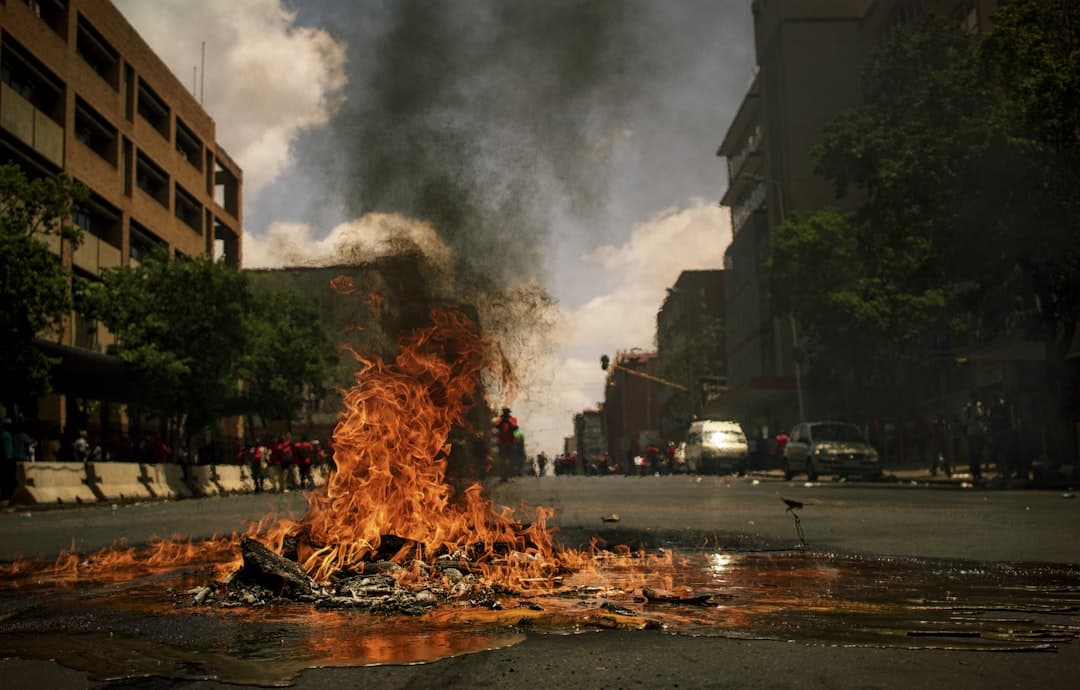
Belfast spent Tuesday night on fire. Masked crowds torched homes, buses, and cars across the city after police charged a 30-year-old Sudanese man with attempted murder over a knife attack. Firefighters dragged people out of burning houses. Police rolled in armored vehicles. It was one of the city's worst nights of violence in years.
The whole thing started with a video. A graphic clip of the stabbing hit social media late Monday, and by Tuesday evening hundreds of people were in the streets. Here is how one attack in north Belfast turned into riots that spread across Northern Ireland and all the way into England.
The attack that set it all off
The stabbing happened around 10:30 p.m. on Monday, June 8, on Kinnaird Avenue in north Belfast. According to police accounts, a man straddled a victim lying in the street and stabbed him over and over in the head, neck, eyes, and back with a kitchen knife.
The victim, a man in his 40s believed to be named Stephen Ogilvie, was rushed to the hospital with serious slash wounds. His condition was described as serious but not life-threatening, and bystanders got the credit for that. Video shows several people tackling the attacker and pinning him down until officers arrived. Police later recovered the kitchen knife at the scene. Far-right accounts shared the clip and called it an attempted beheading.
How fast the city went up
By Tuesday night, June 9, hundreds of protesters, many of them masked, gathered at several points across Belfast. They set a city bus on fire. They burned cars and trash bins. A building on the edge of the city center, in the Sandy Row area, caught fire and residents had to be evacuated. Verified video showed homes engulfed in flames as firefighters ran down the street.
It did not stay in Belfast. In nearby Newtownabbey, protesters set two cars alight. In Kilkeel, another car was torched. Police logged 13 reports of criminal damage and 5 of arson on the first night, some treated as hate crimes. Three officers were hurt, and at least four people were arrested.
Who the suspect is
Police identified the suspect as a 30-year-old Sudanese man. There was early confusion, with police first saying he was believed to be Somali before correcting that.
He was charged with attempted murder, possession of a bladed article in a public place, and threats to kill. Police said there was no sign the attack was terrorism-related and they were not searching for anyone else. Chief Constable Jon Boutcher said there was no trace of the man on any national security database and that he was not known to local police before that night.
The 'Irish route' everyone is now arguing about
The detail that anti-immigration politicians latched onto was how the suspect got into the country. Boutcher said the man traveled from Sudan to Paris, flew from Paris to Dublin, then took a bus from Dublin to Belfast on February 10, 2023, and claimed asylum that same day. He was granted permission to stay until 2028.
Critics call this the 'Irish route.' Northern Ireland shares a land border with the Republic of Ireland, which is in the EU but not the UK. Unlike airports and seaports, that border has no passport checks. So someone can fly into Dublin, cross into Northern Ireland by road, and claim UK asylum on arrival without ever passing a UK border officer. Democratic Unionist Party leader Gavin Robinson urged authorities to curb what he called 'uncontrolled immigration.'
The online pile-on
This is where a local crime stopped being local. The video spread fast because huge accounts pushed it. Anti-immigration activist Stephen Yaxley-Lennon, better known as Tommy Robinson, circulated the clip and told people to 'protest against mass immigration into their communities.' Billionaire Elon Musk reposted content and called for demonstrations.
Reform UK leader Nigel Farage and Restore Britain leader Rupert Lowe demanded details about the attacker. Police asked people to stop sharing the graphic footage and to quit spreading disinformation about the situation. That request mostly got ignored.
The Henry Nowak case fueling the anger
To understand why this blew up so fast, you have to know about another case from the week before. Henry Nowak was a white university student in Southampton, England. He was stabbed to death by Vickrum Digwa, a Sikh man who falsely told police he was the victim of a racist attack. When officers arrived, they handcuffed the dying Nowak and treated him as a suspect before realizing he was the one bleeding out.
Digwa was convicted of murder and sentenced last week to life in prison with a minimum of 21 years. Bodycam footage of Nowak's death was released and set off a national outcry. U.S. Vice President JD Vance blamed immigration for the violence, even though both Nowak and his killer were British. A protest over that case turned violent too, with people throwing chairs and rocks at police.
Protests spread to England
On the same night Belfast burned, demonstrators marched in Southampton at an 'Enough is Enough' protest. They stood outside a hotel that had housed asylum seekers, holding signs that read 'Illegal Migration Is Destroying Our Civilisation' and 'no racism, just patriotism.' A few dozen people also blocked Parliament Square in London.
The Belfast attack and the Nowak case got blended together online into one giant argument about immigration, even though the two had nothing to do with each other. One involved a Sudanese suspect in Northern Ireland. The other involved two British men hundreds of miles away. Online, that distinction got lost.
What the politicians said
Northern Ireland's power-sharing government does not agree on much, but its leaders lined up to condemn the rioting. First Minister Michelle O'Neill of Sinn Fein called the riots 'thuggery' and said there is 'no place for masked thugs to take to the streets and threaten, intimidate, disrupt and cause wanton damage.' Deputy First Minister Emma Little-Pengelly appealed for calm and warned that 'violence damages causes.'
Prime Minister Keir Starmer described the attack itself as 'sickening' and 'horrific.' His office also pushed back at Vance, accusing outside figures of 'trying to interfere in our democracy.' For context, this came after the 2024 unrest tied to the Southport stabbings, when far-right protests led to more than 1,800 arrests across the UK.
What happens next
The suspect was due at Belfast Magistrates' Court on Wednesday, June 10, on the attempted murder charge. Community leaders and clergy spent the night calling for dialogue and restraint while extra police and armored vehicles stayed on the streets.
Strip out the politics and the basic facts are simple. A man was attacked in the street and survived because strangers stepped in. A suspect was charged within a day. Police found no terrorism link. Everything that came after, the burning buses, the evacuated homes, the cross-border arguments and the international pile-on, was a choice people made online and in the street, not something the crime itself required.
Most read
This week